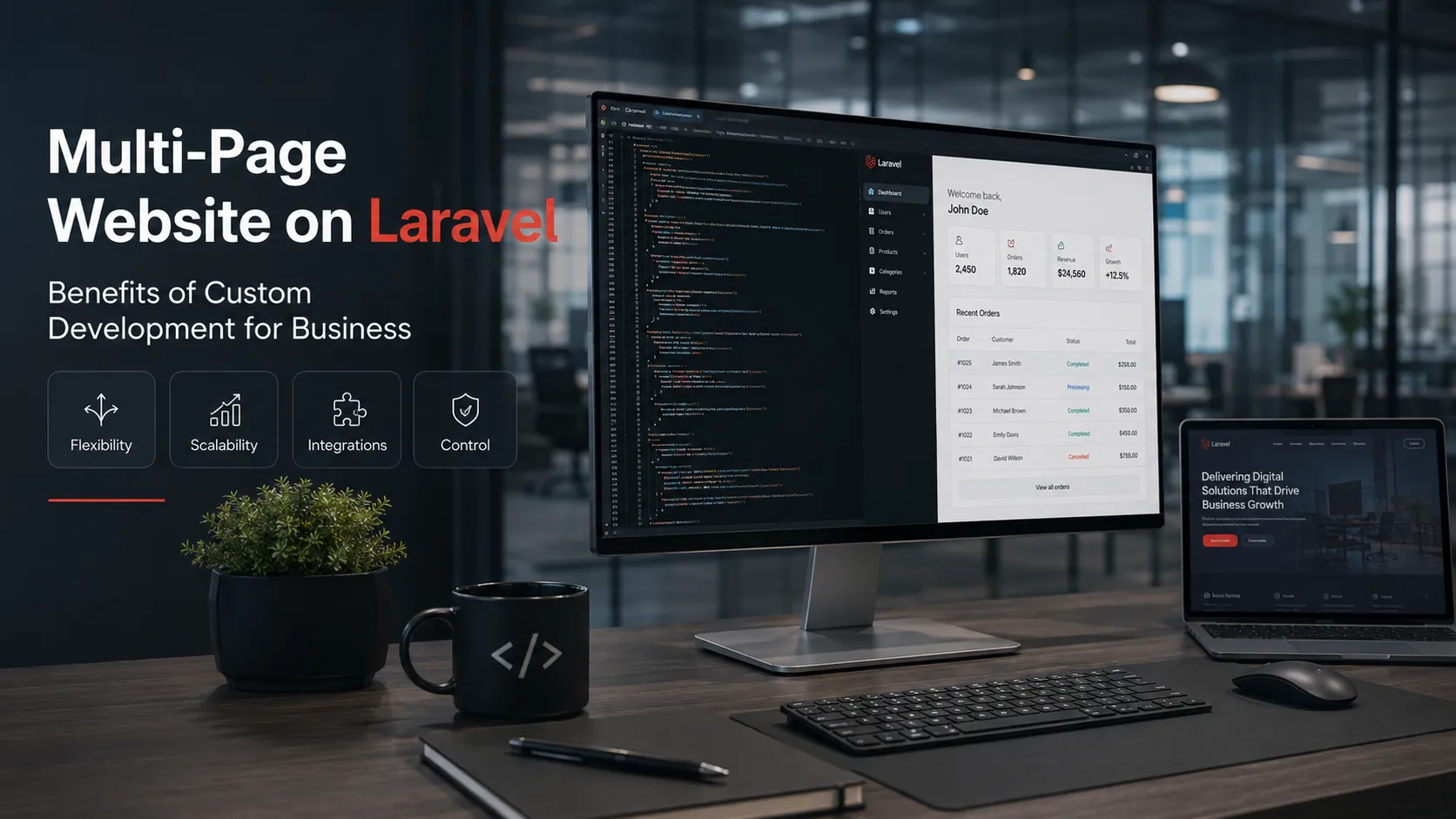
A New Web Philosophy: A Website as a Business System, Not a Template Page
The modern market sets new rules: the era when a company only needed a “beautiful page with service descriptions and contact details” is officially over. If a web resource is expected not just to present a brand, but to actually sell, automate routine tasks, synchronize data with CRM, handle thousands of users, and scale into new business directions, it needs a fundamentally different custom foundation.
That is why a multi-page Laravel website becomes the ultimate solution for companies that think strategically and plan several years ahead. This framework makes it possible to build not a limited website engine, but a flexible digital platform where every line of code works for the company’s real business processes.
Moving From Templates to Custom Architecture
The main value of custom website architecture is complete freedom from the technical limitations of standard CMS platforms. Instead of adapting your business to the capabilities of a ready-made template, you create a tool designed specifically for your company.
A website as a custom business system is built around three fundamental principles:
Full control over data:
All custom functionality — advanced calculators, dealer accounts, complex service filters — is developed from scratch. You receive only what your team and clients actually need, without visual clutter or unnecessary code.Deep process automation:
The website continuously exchanges data with CRM, ERP, warehouse systems, or payment gateways. Managers no longer have to copy requests manually — the system does it instantly.Unlimited potential for growth:
The company can launch new services, add language versions, or create dozens of SEO pages without the risk that the technical foundation will collapse under a large amount of content.
Marketing conclusion:
For a business owner, this transition changes everything. The website stops being an expense for “online presence” and becomes a valuable digital asset. It optimizes the team’s internal workflow, increases the speed of lead processing, and maximizes the return on advertising. This is exactly where the key benefits of custom Laravel development for business become most visible.
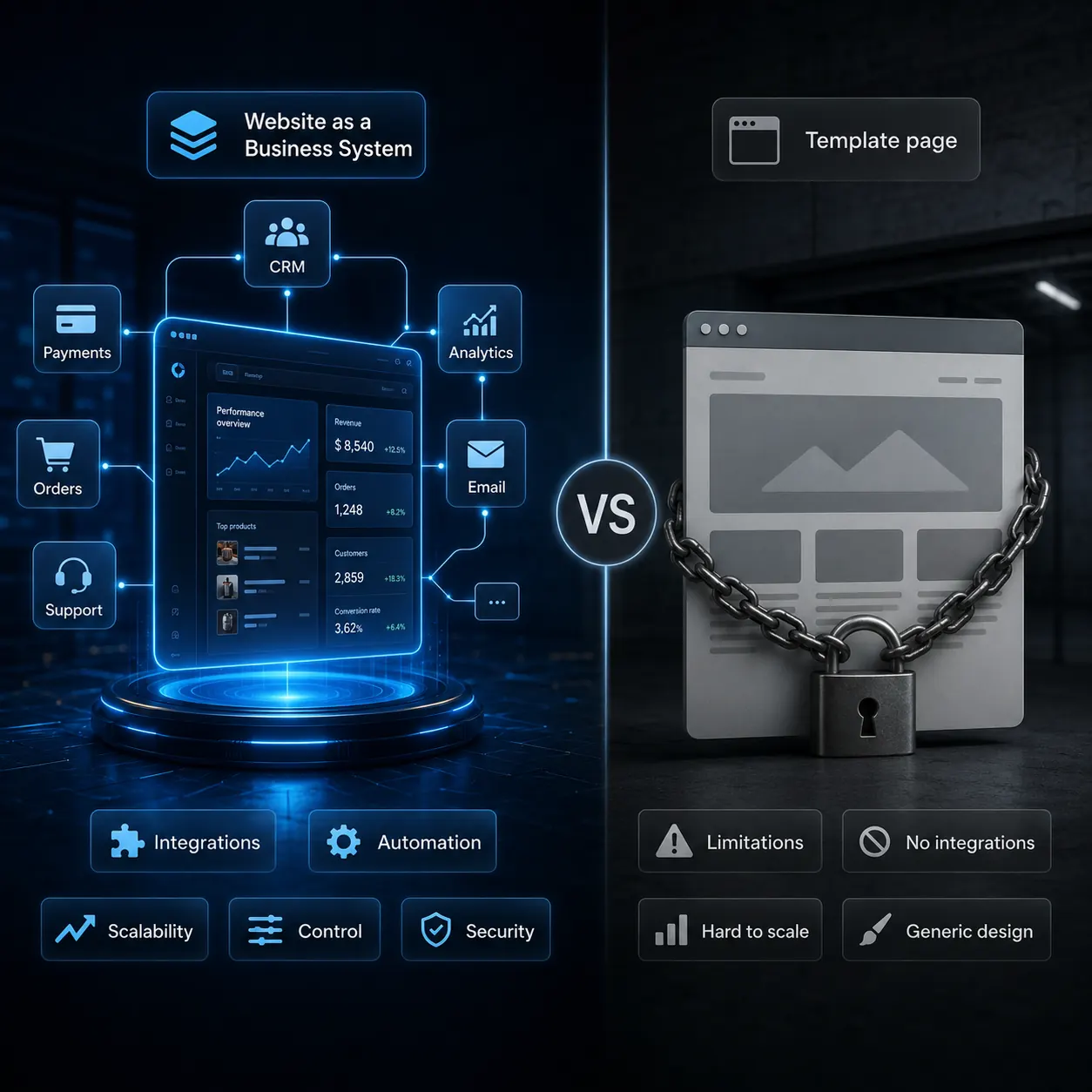
The Technical Ceiling of CMS Platforms: When Out-of-the-Box Solutions Start Hurting the Business
At the beginning, a standard CMS or ready-made out-of-the-box engine may look like a logical choice: quick launch, a familiar admin panel, and a low initial cost. For a simple business card website or a small catalog, this can truly be enough.
But when a company grows, new departments appear, request processing scenarios become more complex, user accounts are needed, custom calculators are added, and thousands of new pages are created — an out-of-the-box solution inevitably hits its technical ceiling.
The problem is not the CMS itself, but the fact that businesses often try to force it to handle engineering tasks it was never designed for. Every new feature is covered by a third-party plugin or a temporary “patch.” As a result, the website becomes overloaded with heavy code, slows down, and requires more and more budget for constant “repairs.”
The “Frankenstein Syndrome”: When a Website Becomes a Set of Plugins Instead of a System
A typical situation looks like this: at first, the business only needed a simple page. Then it added a lead form, CRM integration, multilingual functionality, a user account system, and hundreds of SEO URLs. If all of this is implemented on a ready-made CMS, the website gradually turns into a chaotic set of third-party modules.
Each plugin has its own logic, updates, and scripts that overload the database. As a result, modules start conflicting with each other, lead generation forms work inconsistently, and any automatic system update becomes a technical risk.
Business consequences:
The team spends time not on marketing and sales, but on fighting technical bugs. Leads get lost, managers work slower, and the development of every new feature becomes more expensive because the developer first has to understand the chaos of old plugins.
Architectural Dead End: Why CMS Limitations Block Project Scalability
When scaling, corporate website development on Laravel wins precisely because its architecture is ready for high loads. In out-of-the-box CMS platforms, unique business logic — for example, a custom order processing flow or synchronization of stock balances with ERP — does not work as one unified system.
Ready-made CMS modules function well only within the standard scenarios originally built by template developers. Trying to adapt them to a unique business process requires deep “coding on top of code,” which eventually destroys loading speed and Core Web Vitals.
Business consequences:
Company growth slows down. Instead of quickly testing new marketing hypotheses and launching new branches, the business drains budgets into maintaining an outdated technical foundation that no longer matches the company’s real needs.
How Custom Laravel Website Architecture Solves These Problems
The Laravel framework changes the approach completely: here, the system is designed from scratch around the specific tasks of your company. If you need a custom service catalog, smart filters, partner accounts, or integration with logistics services, all of this is built as part of one clean and unified codebase.
Business consequences:
You receive a custom Laravel website built as a turnkey solution that works predictably and reliably. New modules do not break the existing layout, CRM integrations are automated at the API level, and the technical foundation gives full freedom for marketing and operations.
7 Signs That Your Company Should Move to Laravel
You should not order a framework-based website just because it is trending. However, if you notice at least two signs from this list, your business has already outgrown out-of-the-box solutions:
📉 The website has noticeably slowed down after adding new blocks or language versions.
⚠️ Any technical plugin update creates a risk of breaking forms or design.
🧩 The functionality your marketing team needs cannot be implemented with standard modules.
⚙️ Integrations with CRM, ERP, or warehouse systems constantly break.
👤 The admin panel has become too confusing and inconvenient for content managers.
📈 The company plans major expansion, but the current platform limits this growth.
🔍 SEO optimization requires thousands of unique, fast-loading pages.
In such cases, a multi-page Laravel website becomes not just an alternative to a regular CMS, but the only logical step toward building a reliable digital infrastructure for the company.
Economic Summary of the Section
Out-of-the-box engines are ideal for launch and typical tasks. But at the growth stage, they start generating losses through constant “repair” costs. Moving to Laravel means gaining the long-term benefits of custom development for business. You invest in a clean system without plugin chaos and receive faster launch of new marketing tools, strong data security, and a platform that will never limit the growth of your revenue.
Unlimited Scalability: A Website That Grows Together With Your Company
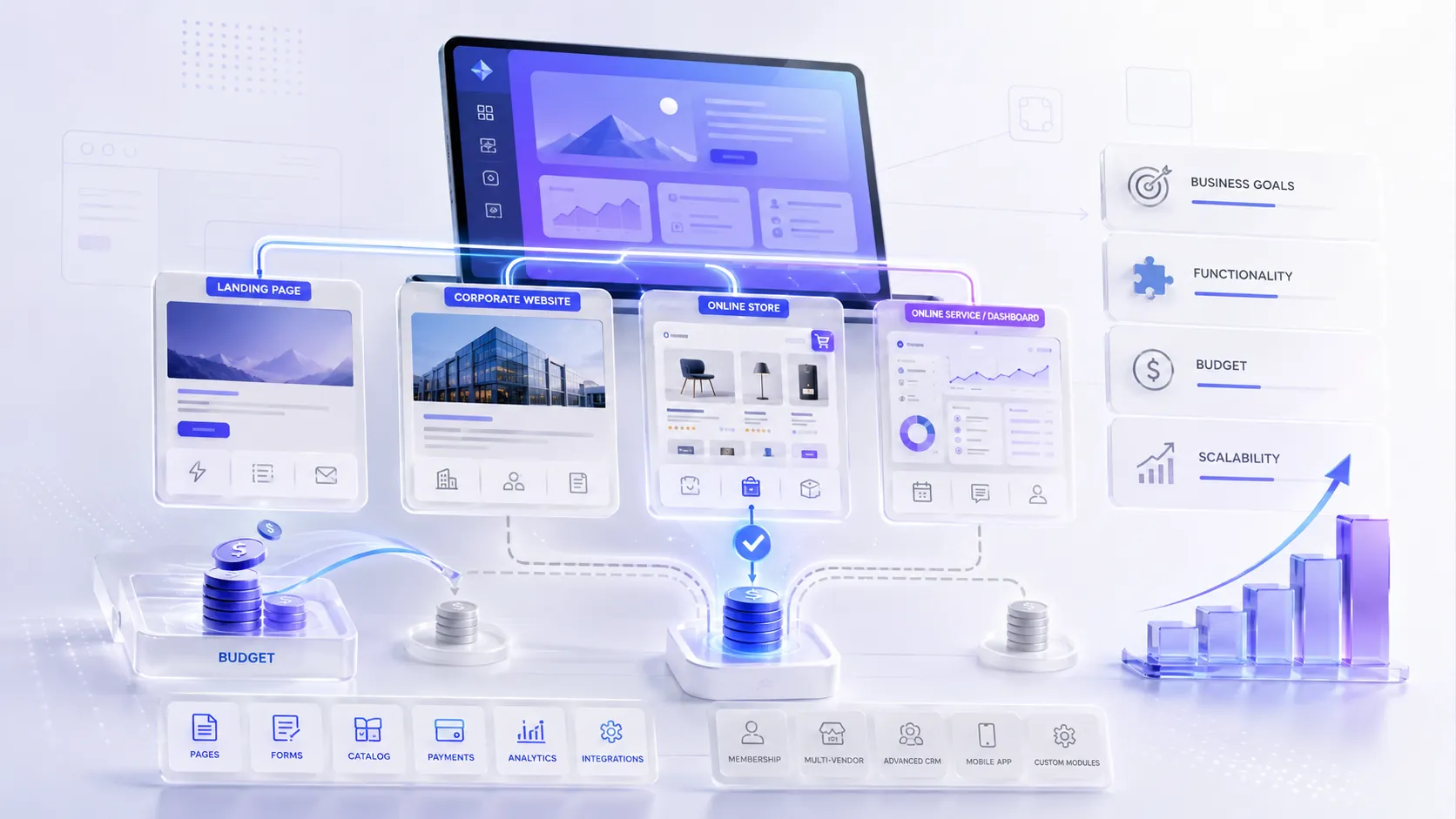
A custom Laravel website built as a turnkey solution is not created around current limitations, but around the future growth vectors of your company. Today, you may only need 20 service pages, a contact form, and a basic admin panel. But in just a few months, your business may launch new directions, open branches in other countries, connect complex calculators, dealer accounts, or internal automation.
This is exactly where the framework reveals its main advantage: the system does not have to be rebuilt from scratch every time. With well-planned architecture, every new module becomes a natural extension of the codebase, not a chaotic add-on.
Evolution: From a Service Website to a Full-Scale Business Platform
At the first stage, the project can function as a classic multi-page Laravel website: presenting services, collecting leads, showcasing case studies, and covering SEO queries in Google.
However, the engineering flexibility of the framework allows functionality to grow smoothly, transforming a regular website into a complex web application. Step by step, you can integrate closed B2B zones, online payment systems, logistics modules, or a custom manager dashboard.
Financial effect:
The company is fully protected from the cost of developing a new website after every stage of scaling. You invest once in a reinforced technical foundation and then flexibly add the business “floors” you need.
Seamless CRM Integration and End-to-End Process Automation
For a business that actively works with paid traffic such as Google Ads or targeted advertising, the “form to email” principle means losing leads. Corporate website development on Laravel allows you to build direct two-level synchronization with any CRM system — Zoho, HubSpot, BAS, or others — through API integration at the core level.
Marketing profit:
The website does not simply send contact details. It transfers the client’s full digital footprint into the CRM: exact traffic source, selected service, calculator data, and behavioral markers. Managers receive a hot lead instantly, which removes the human factor, speeds up request processing, and increases the conversion rate of the sales department.
Modular Architecture: Expansion Without Technical Chaos
The biggest fear during large-scale updates is: “We fix one thing and break another.” In Laravel, this problem is solved at the architectural level of the framework itself through the MVC pattern. Every new tool — whether it is a custom payment gateway or a complex service filtering system — is developed in isolated controllers.
Technical stability:
New features are launched independently and predictably. Marketing teams can freely test new landing pages or promotional mechanics without risking the stable operation of existing integrations, the admin panel, or the mobile version.
Ready for Extreme Loads and Traffic Growth
When marketing works at full power, the load on the database grows exponentially: thousands of simultaneous sessions, massive API requests from CRM systems, and report generation. Weak technical platforms begin to slow down exactly during peak sales moments.
Laravel is designed for high-load projects. It supports professional optimization tools out of the box: queues for heavy background processes, fast data caching with Redis or Memcached, and flexible SQL query optimization.
Business effect:
The website performs flawlessly during seasonal peaks, large-scale advertising campaigns, and rapid SEO traffic growth. Your pages maintain speed within the green zone of Core Web Vitals, protecting the company from losing high-intent potential clients.
Expert Conclusion for B2B
Scalability on Laravel is not about the amount of text on a page. It is about the ability of your digital infrastructure to instantly adapt to a new business model.
Today, you sell services in a local market. Tomorrow, you launch a partner program. In a year, you scale into EU markets with a custom multilingual structure.
The custom code of the framework guarantees that your website will never become a bottleneck for marketing growth. Instead, it becomes a reliable and controllable platform for increasing the value of your brand.
Laravel Admin Panel: Content Management Without Unnecessary Chaos
One of the main fears companies have before moving to a framework sounds like this: “This technology is too complex, and we will not be able to manage the website ourselves.” In reality, the opposite is true. A Laravel user interface is designed specifically around the needs of your team: sales managers, marketers, SEO specialists, and executives.
In standard CMS platforms, the admin panel is usually overloaded with hundreds of unnecessary settings, third-party plugin tabs, and update notifications that only confuse the staff. Custom Laravel website architecture makes it possible to remove all visual clutter. Your team gets a clean, intuitive workspace with only the data and tools they need to perform their direct responsibilities.
1. Filament and Nova Ecosystems: Business-Class Interfaces
Instead of outdated standard panels, corporate website development on Laravel allows the use of modern ecosystems such as Filament or Laravel Nova. These are not just tools for replacing text. They are high-level business interfaces.
Every section of the admin panel is adapted to the logic of your company. Need to update branch pricing, add new SEO pages, or check the CRM integration log? Each action requires only a few clicks because the interface works with clear business objects, not abstract code blocks.
Business effect:
The speed of onboarding new employees increases significantly. The control panel becomes a transparent management tool where it is almost impossible to get confused or accidentally change critical system settings.
2. Flexible Role-Based Access Control and Data Security
When several departments work with the same web resource, giving everyone the same permissions is a major security risk. On Laravel, we build a strict access hierarchy at the core system level.
Each employee receives a unique authorization level:
SEO specialist works in an isolated module: manages meta tags such as Title and Description, configures H1-H3 headings, URLs, redirects, and structured data.
Content manager has access only to publishing materials, service cards, prices, images, and FAQ sections.
Sales manager sees only the lead database, the processing status of online requests, and client comments.
Marketing profit:
You fully protect the client database from unauthorized copying and the technical part of the website from human errors or accidental deletion of important sections.
3. Admin Panel as a Conversion Optimization Center
A modern benefit of custom development for business is that the Laravel website control panel can also work as a primary analytics system. It can display live workload charts, data from custom calculators, lead generation sources, and the response speed of managers.
If a marketer sees that a certain page has high traffic but low conversion, they can instantly test different lead forms, update CTA buttons, or add accent sections without involving developers.
Conversion effect:
Website management becomes a flexible marketing process. The team quickly tests hypotheses, sees clear results inside the admin panel, and adjusts the strategy to increase sales.
Universal Conclusion for Business
When you decide to order a multi-page website based on a framework, you receive not just a set of pages for users, but a closed, secure corporate ecosystem.
A custom Laravel website built as a turnkey solution frees your marketing team from waiting for technical support and gives management full control over digital assets, information security, and the company’s conversion metrics.
Project Economics: Why Investing in Laravel Pays Off
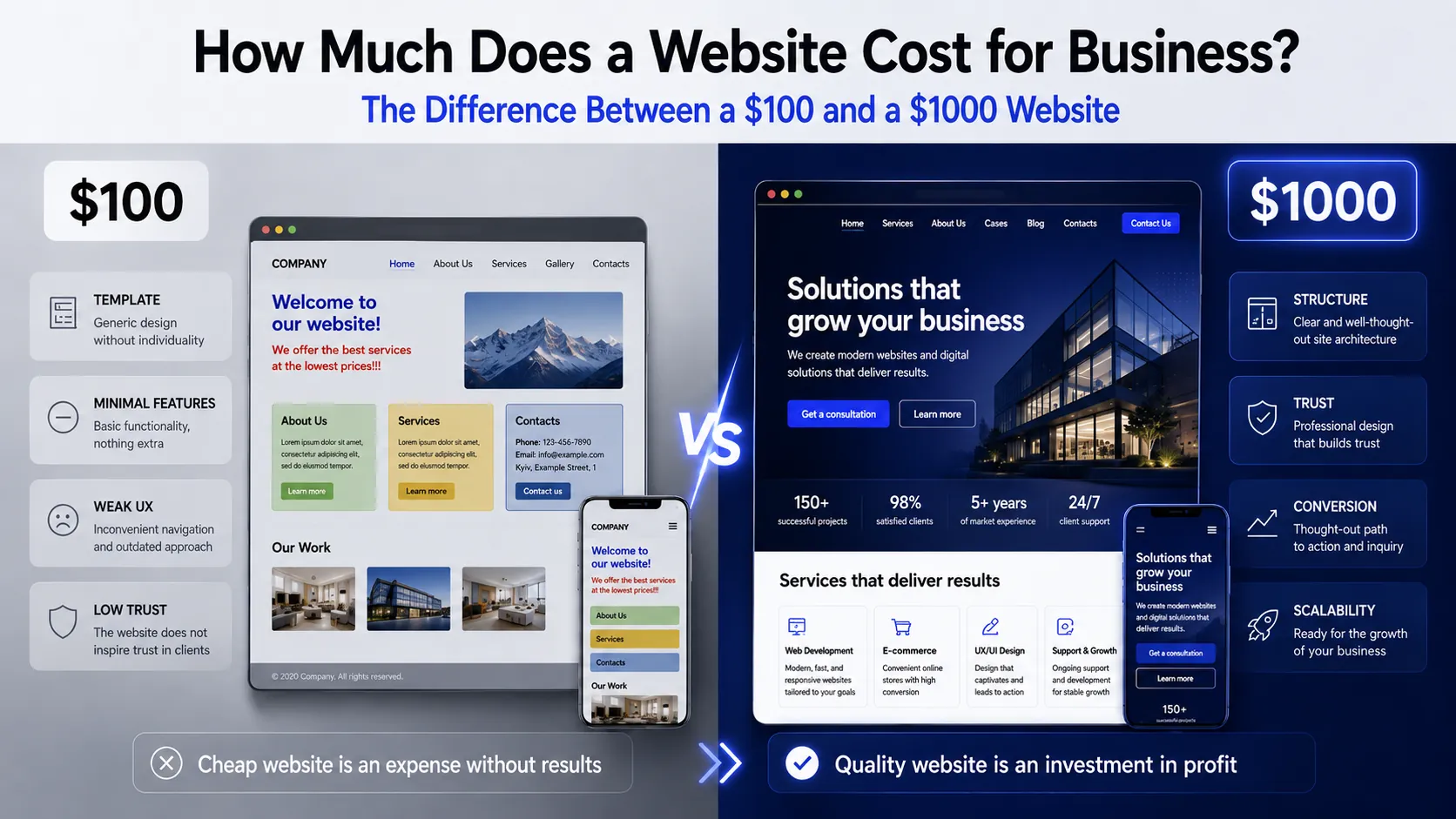
When a company plans to order a multi-page website, the first question for developers almost always sounds the same: “What is the final development cost?” However, for a serious business, it is important to consider not only the initial price, but also TCO — Total Cost of Ownership — the full cost of maintaining the website over 1–3 years. It is in the long run that the difference between a cheap launch on an out-of-the-box CMS and a stable investment in custom code becomes obvious.
At the start, a ready-made engine may look attractive. But when the project begins to expand, complex logistics modules, B2B accounts, and thousands of new pages are added, the initially “cheap” solution starts regularly draining money from the company’s budget.
The Laravel framework works according to a completely different financial logic. Custom development requires a larger investment at the first stage, but the business receives a technically clean system that does not require constant emergency fixes.
1. Eliminating the Hidden Cost of CMS Ownership
The main problem with out-of-the-box solutions is the recurring cost of keeping the system “afloat.” One plugin conflicts with another, an engine update breaks lead generation forms, and a custom CRM integration requires endless paid developer hours.
Economic summary:
Every month, the company spends money not on marketing or launching new products, but on endless technical repairs. Over the course of a year, the total cost of maintaining a plugin-based website can exceed the cost of developing a custom project from scratch.
2. Reducing the Cost of Emergency Technical Fixes
When you order a custom Laravel website as a turnkey solution, all business logic — lead database, user roles, calculators, SEO hubs — is developed as one unified system. Since the code is clean and the architecture is transparent, developers do not have to constantly fix technical conflicts caused by third-party software.
Result for the company:
Technical support changes from a “firefighting service” into planned and predictable product development. The budget goes toward improving conversion and testing new marketing hypotheses, not patching holes in the code.
3. Full Independence From Paid Plugins and Licenses
To implement complex functionality on a CMS, a business often has to purchase PRO versions of dozens of modules: multilingual functionality, SEO filters, security, CRM integrations, and more. Most of them work on a subscription model, creating a constant foreign-currency burden for the company.
Financial profit:
On Laravel, all key functionality is developed individually. You do not accumulate dozens of recurring payments for third-party licenses and are fully protected from the risk that some foreign plugin may shut down or block your account. You own 100% of your custom code.
4. Maximum Time-to-Market Speed for New Tools
When the market changes, marketing teams need to act immediately: launch new landing pages for advertising, connect custom payment gateways, and automate the processing of new types of requests. On template-based platforms, each such idea runs into system limitations.
Marketing effect:
Laravel’s modular architecture allows new services to be added quickly and predictably. The sales department receives the necessary tools without months of waiting, allowing the company to move ahead of competitors and grow revenue faster.
5. Zero Loss of Hot Leads Due to Technical Failures
A website is the main point of contact with the client. If, during a major advertising campaign or seasonal peak, the lead form throws an error, the CRM does not receive contacts, or the page takes more than five seconds to load, the business loses real revenue.
Risk analysis:
Laravel provides rock-solid stability through built-in task queues, automatic error logging, and isolated architecture. Fewer technical failures mean fewer lost clients and maximum return on every marketing dollar.
When Is Corporate Website Development on Laravel Economically Justified?
A custom framework is not necessary for short-term projects or simple business card websites. However, custom development becomes a financially logical and unavoidable step if your plans include:
Systematic and large-scale promotion to the top of Google for thousands of long-tail search queries;
End-to-end automation and deep synchronization with CRM/ERP systems at the API level;
Creation of closed zones, B2B portals, or personal accounts for clients and dealers;
Launch of large volumes of contextual and targeted advertising, where website speed directly affects conversion.
Main Business Conclusion
The question of moving to a framework should not sound like: “Why does a custom website cost more at the start?” Instead, it should sound like: “How much money and stress will the company lose if, in a year, the template-based website starts slowing down, losing leads, and has to be rewritten from scratch?”
From a financial perspective, the benefits of custom Laravel development for business lie in creating a capitalized, secure, and fully controlled digital asset that optimizes support costs and works for the company’s long-term revenue growth.