Website or Social Media: What Does a Business Really Need
Social media has become a fast and convenient starting point for many businesses. Instagram and TikTok help showcase a product, attract attention, build the first audience, receive messages in direct, and quickly test demand. For a small business, this is a useful channel because it allows you to start without complex preparation: publish content, show the process, explain a service, and immediately get a response from people.
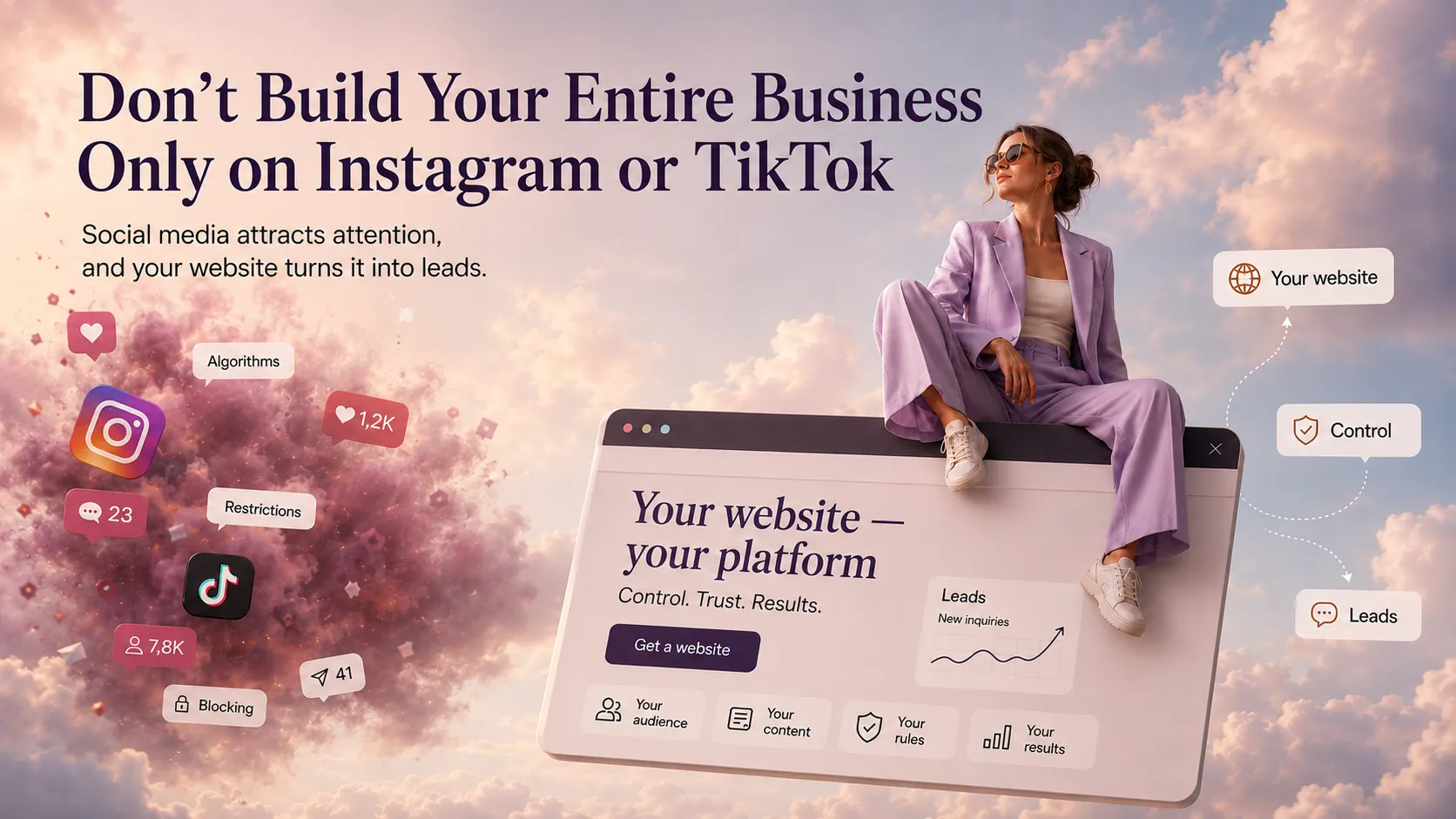
But the problem begins when the entire business depends only on social media. You do not control the algorithms, platform rules, reach, advertising restrictions, or even full access to your own account. Today, a video may get views and bring inquiries, while tomorrow reach drops, the profile gets limited, or customers simply stop seeing your content in the feed. For a business, this is a risk because the channel that brings inquiries can become unstable at any moment.
A website works differently. It is your own platform where the business controls the structure, copy, service pages, case studies, lead forms, analytics, and the customer journey. On a website, you can clearly explain your offer, show advantages, answer common questions, add a portfolio, reviews, pricing, or cooperation terms. In other words, a website does not simply duplicate Instagram — it helps turn a person’s interest into a specific action: an inquiry, consultation, purchase, or booking.
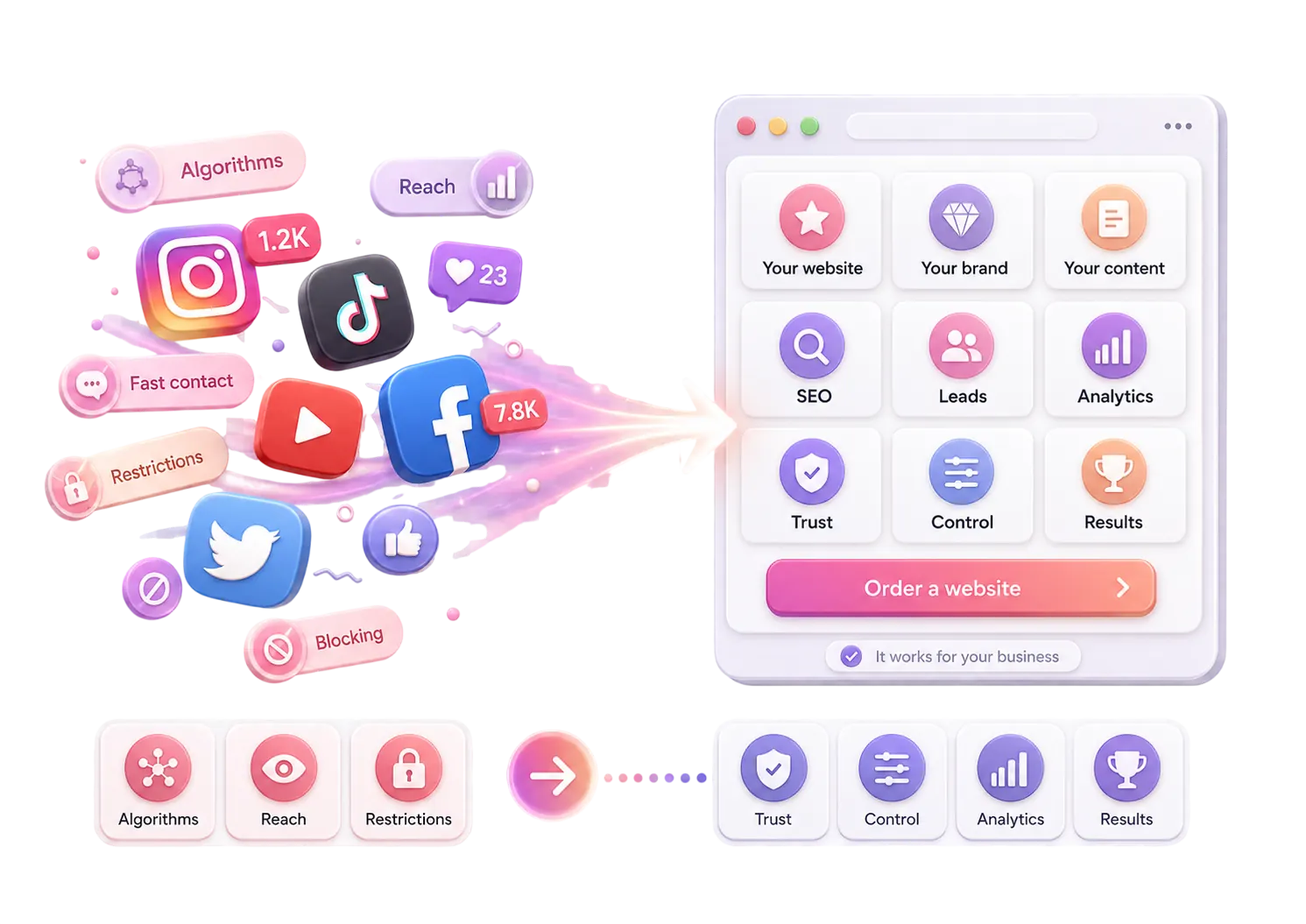
The best solution for business is not to choose between a website and social media, but to combine them. Social media works well for attention, brand awareness, and live communication. A website works for trust, structure, leads, SEO, advertising, and control. When Instagram or TikTok brings a person to the website, they get more information, understand your offer better, and have a clear path to contact you. This connection makes marketing more stable and less dependent on a single channel.
Why Instagram and TikTok Seem Like an Easier Start
Instagram and TikTok seem like an easier start because a business can begin almost immediately. There is no need to wait for website development, plan page structure, set up an admin panel, or prepare a full set of materials. It is enough to create a profile, add a description, contacts, a few photos or videos — and you can already start showing your product or service to an audience.
For a small business, this is genuinely convenient. Social media gives fast contact with people: you can show the work process, new products, reviews, behind-the-scenes content, reply in direct messages, launch ads, or test whether people are interested in your offer. This works especially well for visual niches: clothing, cosmetics, salons, handmade products, food, education, local services, and personal brands.
Another reason is that social media makes it easier to create the feeling of a living business. People see stories, short videos, the faces behind the brand, customer feedback, and the process of fulfilling orders. This helps attract attention faster and create the first connection with the audience. At the beginning, Instagram or TikTok can be a good channel because they do not require much preparation and allow you to quickly test different ideas.
But an easy start does not mean a stable foundation for business. Social media works well as an attention channel, but it cannot always replace a website. It is difficult to present all services, terms, prices, cases, FAQ, SEO pages, lead forms, and complete customer information in a structured way inside a profile. That is why Instagram and TikTok can be a good entry point, but for more serious business growth, it is better to have your own website that receives this traffic and turns interest into inquiries.
Social Media Does Not Belong to Your Business
Instagram and TikTok can bring reach, followers, inquiries, and sales to a business, but the account itself is not fully your own platform. You use a platform that has its own rules, algorithms, restrictions, and technical risks. If the entire business depends only on social media, any platform change can directly affect the number of inquiries.
A website works differently: it is a business-owned space where you control the structure, content, service pages, lead forms, analytics, SEO, and the customer journey. That is why a website should not be seen as a replacement for social media, but as a stable foundation where traffic from Instagram, TikTok, ads, Google, and other channels can be directed.
Why This Matters for Business
When a business works only through Instagram or TikTok, it is essentially building sales on someone else’s platform. Yes, the page may look like your asset: it has your logo, content, followers, reviews, posts, videos, and messages. But the rules of the game are set not by the business, but by the platform itself.
This means you do not fully control who sees your content, how often it is shown, whether the algorithm changes, whether advertising restrictions appear, or whether the account gets reviewed. For a business, this is a risk, especially if all inquiries come from only one channel.
Algorithms Can Change at Any Moment
Today your videos may get views and posts may bring inquiries. But tomorrow the algorithm may change its priorities: show your content less, promote other formats more, or reduce organic reach. A business cannot directly control this process.
That is why relying only on social media reach is risky. If there is no website, SEO, customer base, or other channels, a drop in reach immediately affects inquiries. In this situation, a website works as a stable point where information about the business is available regardless of the feed or recommendations.
An Account Can Be Limited or Blocked
Even if a business operates honestly, an account can still be limited. The reason may be complaints, automatic filters, moderation errors, advertising rule violations, suspicious activity, or technical issues. Sometimes a few problematic signals are enough for a profile to temporarily lose reach or access to ads.
If all customers come only from Instagram or TikTok, such a restriction can stop inquiries. A website reduces this risk: even if social media temporarily fails or an account is limited, the business still has its own platform with contacts, services, lead forms, and pages that can be promoted through Google or advertising.
You Do Not Fully Control the Customer Journey
On social media, the user is constantly distracted: feed, recommendations, messages, other videos, competitors, ads. A person may become interested in your product but quickly switch to other content. In addition, it is difficult to build a full journey from first contact to inquiry inside a profile.
On a website, this journey can be planned much better. You decide what the user sees first, how services are presented, where trust elements are placed, which questions are answered, and where the person should go next: to a form, consultation, purchase, or booking. This gives the business more control over conversion.
Social Media Content Quickly Disappears from the Feed
A post or video may perform actively for a few hours or days, and then disappear in the flow of new content. It becomes difficult for users to find older but important information: terms, prices, service descriptions, answers to questions, work examples, or cooperation details.
On a website, content has a stable structure. Service pages, case studies, FAQ, blog, contacts, and lead forms remain in their places. A person can visit at any moment and find the needed information without scrolling through dozens of posts, stories, or pinned materials.
SEO Is Harder to Build Through Social Media
Social media can provide reach inside the platform, but it does not replace a full SEO structure. If a person searches on Google for a specific service, price, solution, or company in their city, a website has more opportunities to appear in search through separate pages, articles, headings, metadata, and content structure.
Without a website, a business often loses people who already have clear demand and are looking for a solution right now. Instagram and TikTok help create interest, while a website can work with those who are already searching for a service through Google.
It Is Harder to Collect and Analyze Inquiries Systematically
In direct messages, inquiries can get lost among messages, reactions, questions, and non-target conversations. It is often difficult to understand where the customer came from, which content worked, which services people are interested in, and where they drop off before contacting.
On a website, forms, events, analytics, goals, CRM integrations, or email/Telegram notifications can be set up. This helps the business see not just “someone wrote”, but the full picture: where the person came from, which page they viewed, which button they clicked, and what request they submitted.
A Website Reduces Dependence on One Channel
The strongest position for a business is not to depend on only one source of customers. If there is only Instagram, any drop in reach affects sales. If there is only TikTok, an algorithm change can reduce the flow of inquiries. If there is a website, the business can receive traffic from different sources: social media, Google, advertising, email, partners, QR codes, or offline materials.
A website becomes the central point where people from all channels can be directed. This makes marketing more stable: social media attracts attention, and the website receives that attention, explains the offer, and turns it into an inquiry.
One Ban Can Stop All Inquiries
If a business fully depends on Instagram or TikTok, the account becomes not just a content page, but the main sales channel. People use it to view products, send direct messages, ask questions, book services, or place orders. But if this account gets restricted, blocked, or affected by a “shadow ban”, the flow of inquiries can stop almost immediately.
The problem is that restrictions do not always happen because of a serious violation. They can be caused by complaints, automated moderation, suspicious activity, repeated messages, algorithm errors, advertising restrictions, or incorrectly formatted content. A business may operate honestly and still temporarily lose reach, access to ads, direct messages, or even the entire profile.
For a business, this is a serious risk: if customers know you only through social media, they may simply not find another way to contact you. Without a website, there is no separate page with services, contacts, lead form, pricing, case studies, or alternative communication channels. As a result, an account issue becomes not just a technical inconvenience, but a real loss of inquiries and sales.
A website works as a safety net in this situation. Even if a social media platform is temporarily unavailable, the business still has its own place where customers can find information, view services, submit a request, message through another channel, or call. That is why social media is best used as an attention channel, while the website should be the stable foundation that does not depend on one account.
It Is Hard to Explain a Complex Service on Social Media
Instagram and TikTok work well when the goal is to quickly attract attention: show a result, emotion, process, short review, or strong visual. But when a service is more complex, more expensive, or requires trust, a few posts or short videos are often not enough. The customer needs to understand not only “what you do”, but also how it works, what is included, why they can trust you, and what result they will get.
On social media, information gets lost quickly. One post explains the terms, another shows pricing, another presents case studies, and another describes the work process — and the customer has to search for answers across the feed, stories, highlights, or direct messages. If the person does not get a clear picture quickly, they may postpone the decision or go to a competitor who explains everything more clearly.
A website helps organize a complex service into clear logical sections. On a separate page, you can show the service description, benefits, work stages, examples, pricing, FAQ, reviews, case studies, guarantees, documents, lead form, and contacts. The customer does not jump between posts — they follow a clear path: read, compare, remove doubts, and understand what to do next.
This is especially important for services where decisions are not made impulsively: website development, legal services, financial solutions, education, healthcare, consulting, renovation, construction, B2B services, or any high-ticket service. In such niches, a website works like a calm consultation: it explains, structures information, builds trust, and helps the customer take the next step.
Social media can make a person interested, but a website helps convince them. On a website, a business can show its expertise, answer objections, explain the value of the service, and turn interest into an inquiry. That is why for complex services, a website is not just an addition to Instagram or TikTok — it is an important part of the sales process.
Social Media Attracts Attention, a Website Turns It into an Inquiry
Social media works well for the first contact. A person sees a TikTok video, an Instagram story, a short post, a review, or an example of your work — and notices your business for the first time. This is the strength of social media: it quickly introduces the audience to the brand, shows emotion, process, result, and creates interest.
But attention alone does not mean an inquiry. A person may become interested, but they need more information: what services you provide, how much it may cost, how the process works, why they can trust you, what examples you have, what is included in the service, and how to take the next step. If this information is not available in one clear place, the interest can quickly disappear.
This is where a website becomes important. It receives the person after social media and guides them further: explains the offer, shows advantages, structures services, adds case studies, reviews, FAQ, contacts, and a lead form. The customer does not need to search through posts and stories — they land on a page where everything is organized clearly and conveniently.
A proper website works as a continuation of marketing. Social media creates interest, and the website helps not to lose it. It answers the customer’s questions, removes doubts, strengthens trust, and leads to action: submit an inquiry, book a consultation, buy a product, reserve a service, or contact a manager.
For a business, this means more control over the customer journey. You are not just waiting for a person to send a direct message. You give them a clear path: saw the content → visited the website → understood the offer → saw trust signals → submitted an inquiry. This connection works much stronger than just having a social media profile without your own platform.
A website helps not to lose a warm audience. If a person has already become interested in your content, it is important to give them a place where they can calmly make a decision. That is why a website is not an “extra option”, but a tool that turns attention from Instagram or TikTok into real inquiries for the business.
A Website Can Bring Customers from Google
Social media works through feeds, recommendations, and algorithms. A person sees your content when the platform decides to show it. A website works differently: it can be found by people who are already searching for a specific service, product, or solution on Google. This audience is highly valuable because they did not just randomly see your content — they already have interest or intent.
For example, a user may search for: “order a website for business”, “online booking for a salon”, “turnkey online store”, “accounting services”, “car repair near me”, or “English courses for children”. If a business has a well-structured website with service pages, clear copy, SEO titles, meta descriptions, and useful materials, it has a better chance of appearing in search results for these queries.
The main advantage of Google is that the customer often comes with intent. On social media, you compete for attention among entertainment, videos, stories, and recommendations. In search, the person enters a query because they want to find something, compare options, order a service, or check a price. A website helps meet this customer at the moment when they are closer to making a decision.
For a website to bring customers from Google, it needs more than just one “About us” page. It should have a proper structure: separate service pages, clear headings, useful copy, answers to common questions, case studies, contacts, fast loading, and mobile adaptation. For many businesses, a blog or materials section also works well because it allows the company to answer customer questions and gradually attract organic traffic.
A website does not bring instant SEO results in one day, but it creates a long-term foundation. A social media post can quickly disappear from the feed, while a well-written page or article can work for months and bring new visitors. That is why a website is not only a place for information, but also a channel that can steadily attract customers from search.
What Website to Start With If Your Business Already Has Social Media
If a business already uses Instagram or TikTok, the website does not have to be large or complex from the very beginning. The main thing is to understand what task it should solve after social media: collect inquiries, explain services, show a catalog, sell products, accept bookings, or build trust in the company.
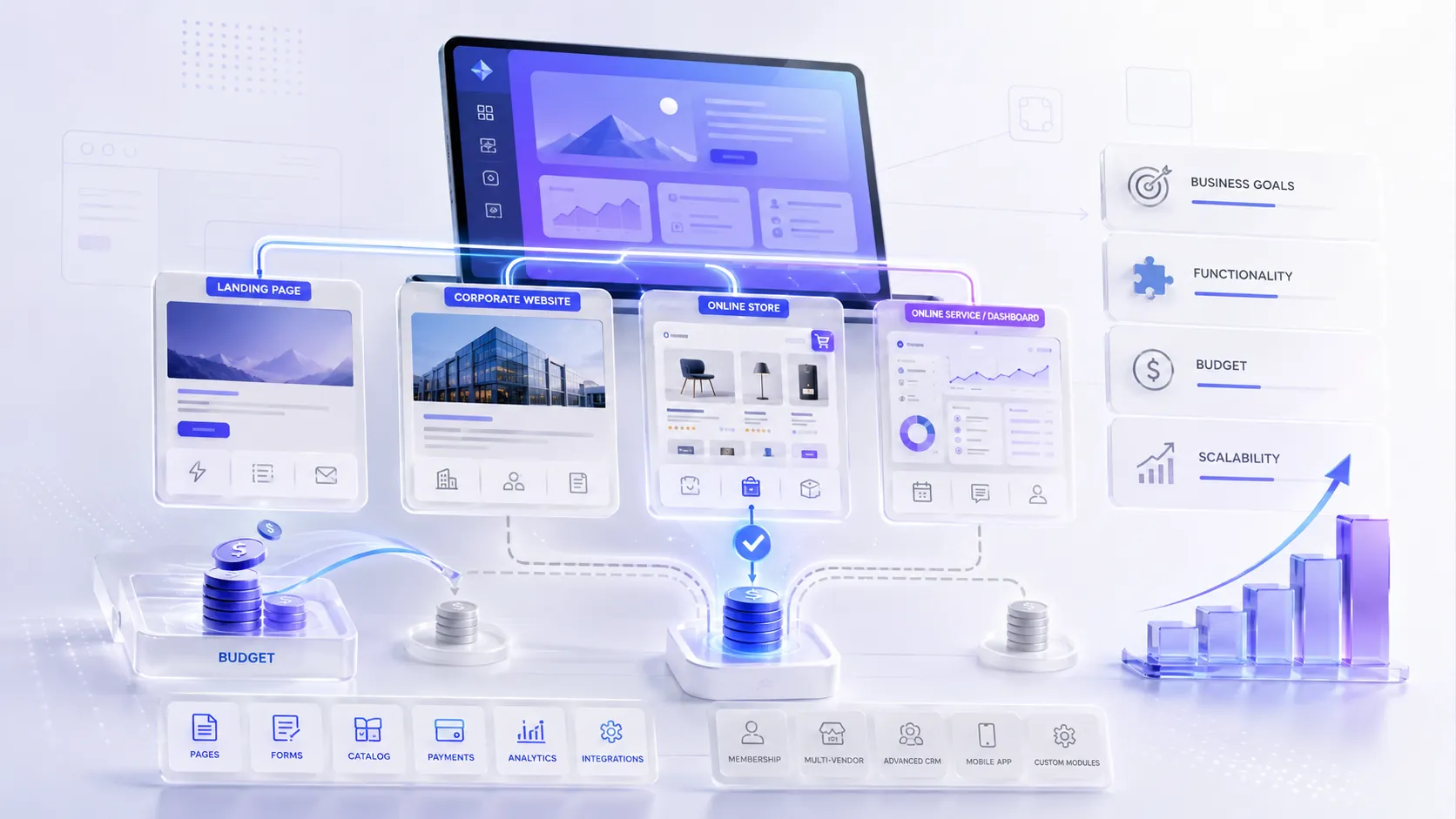
The best start is not “just any website”, but the format that fits your business model. For an individual service provider, a landing page may be enough. For a company with several areas, a corporate website is better. For products, a catalog or online store may work best. For bookings and accounts, an online service is more suitable.
If You Have One Service or One Strong Offer
For a business that promotes one main service through Instagram or TikTok, the best starting point is often a landing page. For example: a consultation, course, workshop, specific procedure, repair service, product launch, or special offer.
This type of website should quickly explain what you offer, who it is for, what the value is, what benefits you provide, show reviews, examples, and a lead form. Social media attracts attention, while the landing page receives that attention and guides the person to a specific action: book, submit a request, or ask for a consultation.
If You Have Several Services and Need to Explain the Business
If a business has several directions, different services, a team, case studies, experience, and wants to look more professional, it is better to start with a corporate website. This works well for studios, agencies, clinics, educational projects, service companies, financial, legal, construction, or B2B businesses.
A corporate website helps structure information: homepage, separate service pages, about company, case studies, FAQ, contacts, and reviews. On social media, a person may become interested in you, while on the website they can calmly understand what exactly you do, why they can trust you, and how to contact you.
If You Sell Products but Orders Still Go Through Direct Messages
If you have an Instagram or TikTok shop where customers ask about price, availability, size, color, or delivery in direct messages, it may be worth starting with a catalog website. This is a good first step if you are not ready for a full online store yet, but already want to present products more conveniently.
A catalog website allows you to divide products into categories, add photos, characteristics, filters, descriptions, price, or a “Ask / Order” button. The customer does not need to scroll through dozens of posts in a profile — they go to the website and quickly find the needed item.
If You Want to Sell Products Fully Online
If the business already has stable demand on social media and wants to reduce manual work in direct messages, it is better to move to an online store. This is suitable for clothing, cosmetics, accessories, home goods, auto parts, gifts, handmade products, electronics, or any products with repeat sales.
An online store helps automate the purchase: the customer chooses a product, adds it to the cart, places an order, selects delivery and payment. For the business, this means less chaos in messages, less manual processing, and more control over orders.
If Customers Book Services
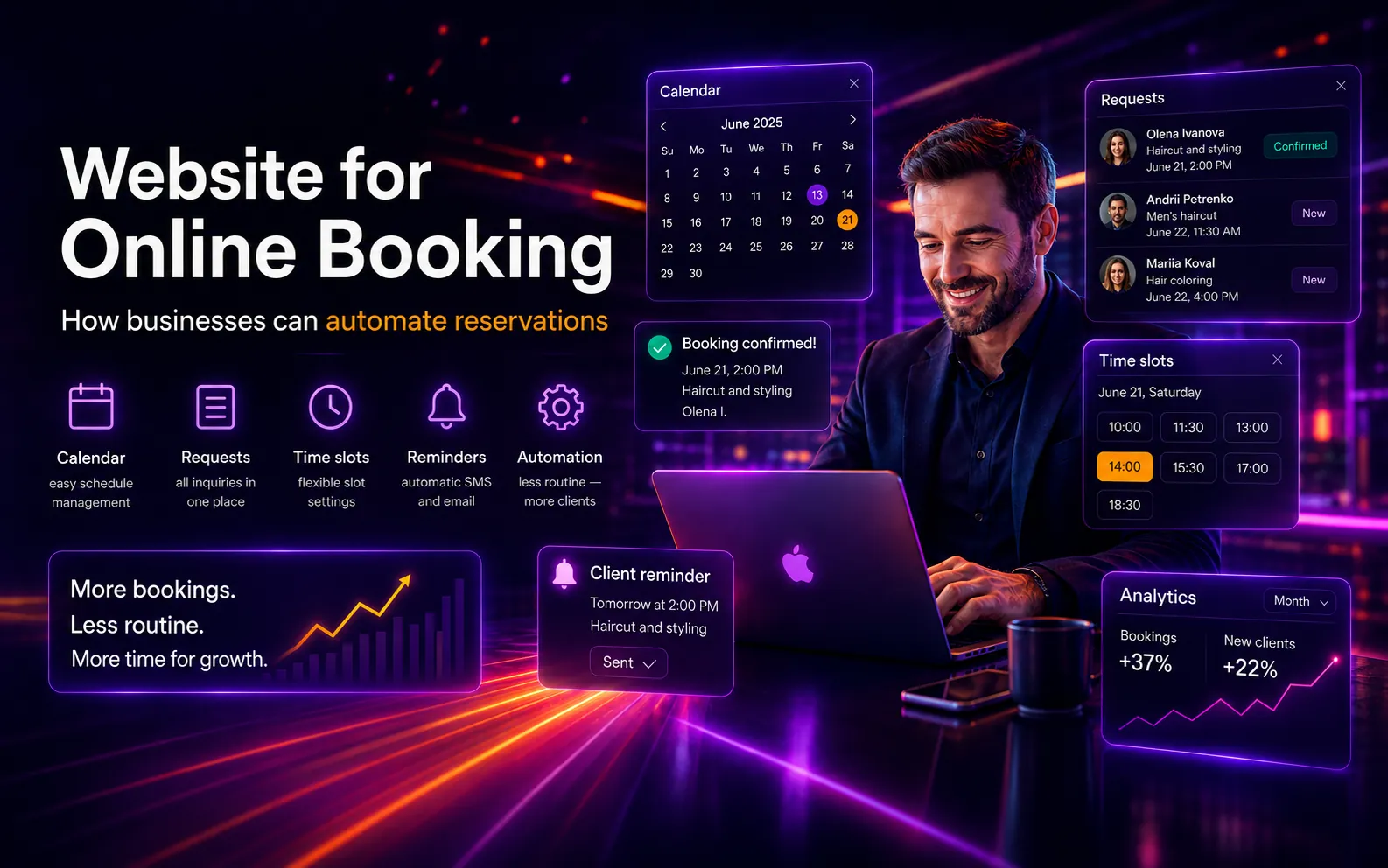
If your business works through appointments — salon, barbershop, auto service station, clinic, studio, trainer, consultant, or educational project — it is worth considering a booking website or online service. Social media can bring people in, but the booking process itself should be more convenient and systematic.
On such a website, the customer can choose a service, date, time, specialist, or consultation format. The business can see requests, statuses, schedule, and notifications without losing bookings in direct messages. This is especially useful when inquiries increase and manual messaging starts taking too much time.
If You Sell an Expensive or Complex Service
For expensive or complex services, social media is often not enough. If the customer needs time to think, compare, understand the work stages, see case studies, and get answers to objections, it is better to start with a corporate website with service pages.
This is suitable for website development, financial services, consulting, legal services, healthcare, construction, education, B2B, or complex services. Such a website should not simply “sell”, but explain, build trust, and help the customer make a decision.
If You Have a Personal Brand
If you are an expert, specialist, teacher, consultant, coach, designer, photographer, or freelancer, you can start with a portfolio website or a small personal website. Social media shows your activity well, but a website helps collect everything important in one place.
On such a website, you can show who you are, how you help, what services you provide, what results you have, reviews, work examples, and how to contact you. This makes the personal brand look more professional and less dependent on one social media profile.
If You Simply Want to Receive Traffic from Social Media
If the main sales still happen through Instagram or TikTok, but you want to have your own destination for the profile link, you can start with a small business website or landing page. This is better than sending people only to direct messages because the page can briefly explain the offer, show services, benefits, contacts, and a lead form.
Such a website can be the first step toward a larger system. At first, it receives traffic from social media, and later it can be expanded with service pages, blog, catalog, SEO, case studies, FAQ, or integrations.
What to Add to a Website So It Can Receive Traffic from Social Media
If a person visits your website from Instagram or TikTok, they are already somewhat interested in your business. But interest alone is not enough to get an inquiry. The website needs to quickly explain who you are, what you offer, why you can be trusted, and what action the user should take next.
A website after social media should work as a “receiving point” for warm traffic. The person should not get lost, search for information across different pages, or wonder where to click. The clearer the path from viewing content to submitting an inquiry, the higher the chance that social media interest will turn into a real customer.
Clear Hero Section
The hero section should immediately explain where the person has landed and what value they can get. If a user comes from TikTok or Instagram, they usually have little patience: they quickly evaluate the page and decide whether to stay or leave.
The first screen should include a clear headline, a short offer description, a call-to-action button, and a visual that matches your business. For example: “Website Development for Business”, “Online Booking for a Salon”, “Product Catalog with Delivery”, or “English Courses for Children”.
One Main Action
The website should clearly show what you want the user to do: submit an inquiry, book an appointment, buy a product, view a catalog, message in a messenger, or reserve a service. If there are too many buttons leading in different directions, the person may get confused.
It is better to choose one main action and repeat it in key places on the page. For example: “Get a Consultation”, “Book Online”, “View Catalog”, “Calculate Price”, or “Submit a Request”.
Short Explanation of Services or Products
A person from social media may have already seen your content, but they may not fully understand your offer. That is why the website should briefly and clearly show what exactly you sell or what services you provide.
If these are services, add separate sections or pages for each direction. If these are products, show categories, popular items, or a catalog. The main goal is for the customer to quickly understand: “Yes, this is exactly what I need.”
Trust Section
After social media, a person may be interested but not yet ready to contact you. They need proof that the business is real, professional, and reliable. That is why it is important to add a trust section to the website.
This can include case studies, work examples, reviews, process photos, client logos, certificates, numbers, experience, guarantees, or a short explanation of your approach. For complex and expensive services, this section can strongly influence the customer’s decision.
Answers to Common Questions
On social media, customers often ask the same questions: how much it costs, how to order, what the timeline is, what is included, whether delivery is available, how booking works, or what the cooperation terms are. If these answers are available on the website, the person can make a decision faster.
FAQ helps remove doubts before the first contact. It saves time for both the business and the customer: instead of long direct-message conversations, the person can find the answer on the website and submit an inquiry right away.
Convenient Inquiry or Booking Form
If the website receives traffic from social media, the inquiry form should be simple. There is no need to ask for too much information immediately. The longer the form, the higher the chance that the person will not complete it.
At the start, name, phone number or messenger, a short request description, and a submit button are often enough. If it is booking, you need service, date, time, and contact details. It is important that the form works reliably, inquiries are not lost, and the business receives notifications quickly.
Contacts and Messengers
Not every user wants to fill out a form. Some prefer to call, while others prefer Telegram, Viber, WhatsApp, or Instagram. That is why the website should have visible and convenient contact options.
Quick contact buttons, a contact section, clickable phone number, email, map, working hours, and social media links work well. It is important not to hide contacts at the bottom of the page so the user has to search for them.
A Page for a Specific Campaign
If you launch ads or create a series of videos for a specific service, it is better to send people not just to the homepage, but to a separate landing page. It should match what the person saw on social media.
For example, if the video is about online booking, the page should lead to booking. If the post is about a specific service, the page should explain that exact service. This makes the user journey more logical and increases the chance of getting an inquiry.